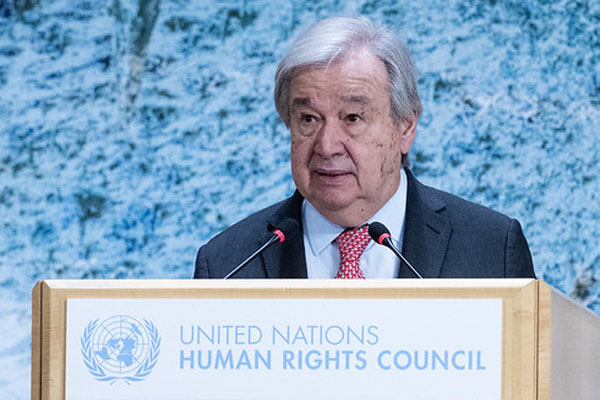
INTERNATIONAL – The United Nations Secretary-General António Guterres has warned the Security Council that the Middle East is on the brink of a wider war following joint US-Israeli strikes on Iran and retaliatory attacks by Tehran.
Thank you for reading this post, don't forget to subscribe!Addressing an emergency council session convened in the wake of the escalation, the UN chief described the escalating violence as a grave threat to global peace and called for immediate action to prevent further conflict.
Guterres reminded member states of their obligation under the UN Charter to avoid the threat or use of force, warning that the ongoing military action risks igniting an uncontrollable chain of events across the volatile region.
“The UN Charter obligates all member states to refrain from the threat or use of force in their international relations. The ongoing military action, which has now drawn in several nations, risks sparking an uncontrollable chain of events in the world’s most volatile region,” the UN chief warned.
He urged an immediate halt to fighting and a return to negotiations on Iran’s nuclear programme, noting that the joint strikes had squandered a diplomatic opportunity presented by ongoing indirect talks between the US and Iran.
“The joint operation squandered a diplomatic opportunity during ongoing US-Iran talks mediated by Oman. We call for an immediate return to negotiations on Iran’s nuclear programme and an urgent cessation of hostilities,” Guterres stated.
Meanwhile France, through its Ambassador, Jérôme Bonnafont, called on Iran to respect its international obligations and cooperate fully with the UN nuclear watchdog, stressing that adherence to international law is essential for lasting security.
Russia’s Ambassador, Vassily Nebenzia, launched a blistering attack on the US and Israel, describing the strikes as an unprovoked act of aggression against a sovereign state and a reckless step that betrayed diplomacy.
China condemned the use of force to settle disputes, expressing sadness over the loss of civilian life and demanding that the sovereignty and territorial integrity of Iran and all regional countries be respected.
China’s Ambassador, Fu Cong, also echoed the UN chief’s dismay that the attacks came while diplomatic negotiations between the US and Iran were still underway.
The US Ambassador, Mike Waltz, defended the military action, stating the strikes targeted Iran’s ballistic missile capabilities and naval assets.
He insisted the objective was to ensure Iran could never threaten the world with a nuclear weapon, adding that no responsible nation could ignore such persistent aggression and violence.
“The joint strikes are targeting Iran’s missile capabilities and naval assets to ensure the Iranian regime can never, ever threaten the world with a nuclear weapon. No responsible nation could ignore such persistent aggression and violence,” Ambassador Waltz asserted.
Israel’s Ambassador, Danny Danon, described his country’s strikes as an act of necessity to stop an existential threat, accusing Tehran of building nuclear weapons in defiance of international law while declaring its intention to erase Israel.
Iran’s Ambassador, Amir Saeid Iravani, vehemently rejected US and Israeli justifications, describing the joint operation as premeditated aggression and accusing the two nations of deliberately attacking civilian areas.
He declared the strikes a war crime and a crime against humanity, dismissing their legal basis as devoid of foundation and categorically rejecting all claims regarding Iran’s nuclear programme.
The US and Israel launched major attacks on Iran on February 28, targeting military sites and nuclear facilities, which killed several Iranian leaders including Supreme Leader Ali Khamenei. Iran responded with retaliatory strikes on US and Israeli targets across the Middle East, further escalating the conflict.
The violence has spread rapidly, with Hezbollah attacking Israel and Iran striking US military bases in Bahrain, Kuwait, and Qatar. Global markets have felt immediate effects as energy prices surge due to disruptions at key facilities.
The international community remains divided, with Russia and Qatar urging restraint while other nations have voiced support for the US-Israeli actions. The conflict has also raised fears of broader instability as attacks on embassies and civilian areas continue.
The situation remains highly volatile, carrying serious implications for global security and energy supplies. World leaders are watching closely as the risk of further escalation threatens to draw more nations into the conflict.
About the Author