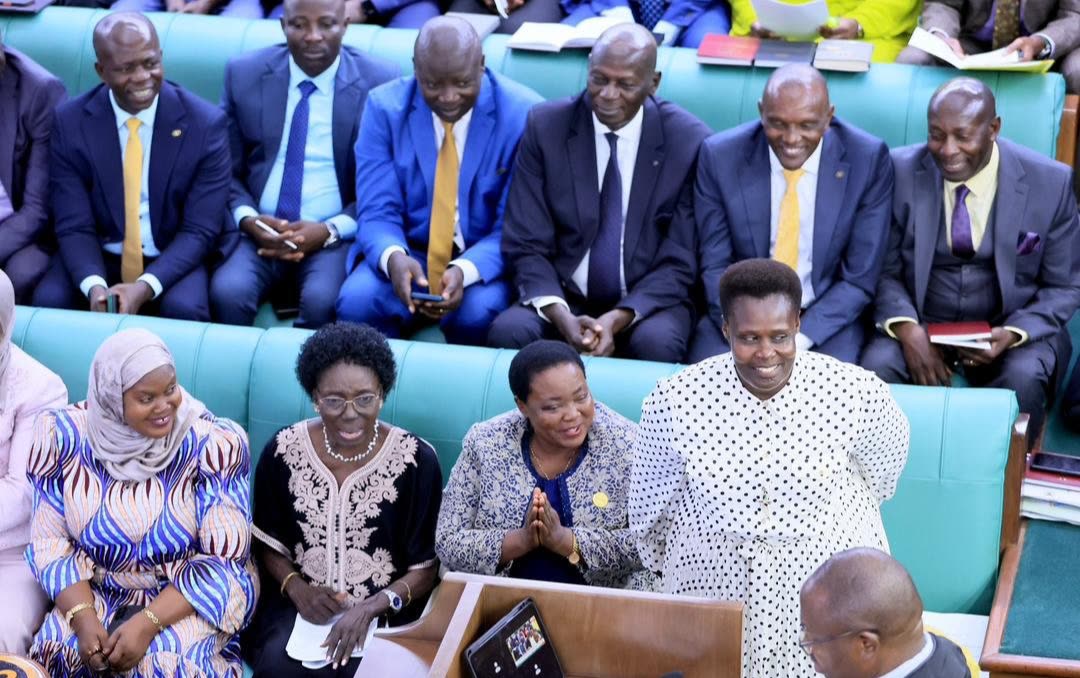
KAMPALA – The Parliament of Uganda has approved the appointment of Rt. Hon. Robinah Nabbanja as Prime Minister and Leader of Government Business, alongside H.E. Maj. (Rtd) Jessica Alupo as Vice President.
Thank you for reading this post, don't forget to subscribe!The approvals, which dominated the afternoon session of the 12th Parliament, were presided over by the Speaker, Rt. Hon. Jacob Marksons Oboth.
The endorsements came directly following a formal proposal from the President of Uganda, Gen. Yoweri Kaguta Museveni, as part of the newly unveiled 2026–2030 Cabinet lineup.
The motion to approve the Vice President was moved by Hon. Ephraim Kamuntu, receiving robust secondments from prominent legislators including Hon. Minsa Kabanda and Hon. Catherine Lamwaka.
Shortly thereafter, the Lira City Woman MP, Hon. Dr. Jane Ruth Aceng Ocero, moved the motion to confirm Rt. Hon. Nabbanja as Prime Minister, a move solidly backed by MPs Dennis Namara, Esther Anyakun, and others.
Following her confirmation, Prime Minister Nabbanja, who also serves as the Kakumiro District Woman MP, swiftly moved a consequential motion seeking parliamentary approval to expand the scope of government.
The request aimed to increase the number of Cabinet Ministers from 21 to 30 and the number of State Ministers from 21 to 51.
Prime Minister Nabbanja defended the proposed cabinet expansion before a packed house with a data-driven argument for evolving governance structures.
She noted that Uganda’s governance landscape has changed sharply since the 1995 Constitution was enacted, as her motion focused on efficiency, accountability, inclusivity, and alignment with Vision 2040 and the National Development Plan.
“This motion is not about numbers alone; it is about efficiency, accountability, inclusivity, and alignment with Vision 2040 and the National Development Plan,” Hon. Nabbanja stated.
She cited a dramatic increase from 39 to 146 districts and population growth from 20 million to 45.9 million, arguing that Uganda’s unique demands justify the constitutional adaptation.
The debate saw legal scholars in the legislature weigh in, with Kyaka South County MP Hon. Jackson Kafuuzi offering a critical constitutional defense of the proposal.
Citing Article 111 of the Constitution, Kafuuzi stressed that the issue was not merely about numbers but the constitutional organization of government functionality following a fresh electoral mandate.
“We are not merely approving names or adjusting numbers; we are building a cabinet that reflects Uganda’s growth, honors its constitutional framework, and equips this government to deliver on the people’s mandate for the next five years,” MP Kafuuzi stated.
Following lengthy and vigorous arguments, the legislators adopted a resolution to vary the total number of Cabinet Ministers and other Ministers, acting in strict accordance with Articles 113(2) and 114(2) of the Constitution.
The landmark decision clears the constitutional path for the President’s recent appointments of 30 Cabinet Ministers and 51 Ministers of State.
About the Author