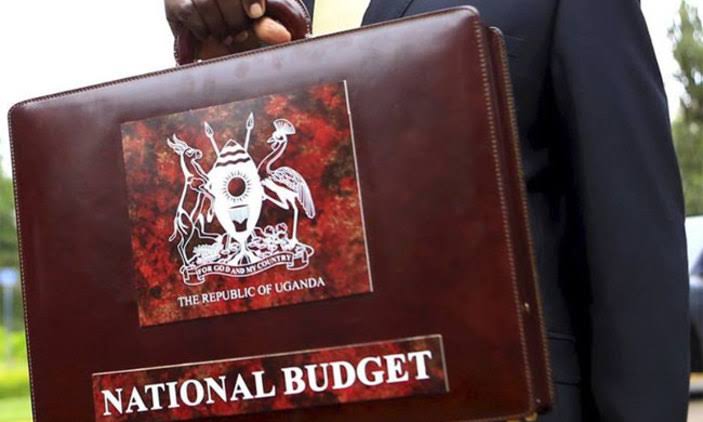
KAMPALA – The Government of Uganda has released Shs 21.82 trillion for the Second Quarter (Q2) of the Financial Year 2026/27, equivalent to approximately 26 percent of the approved annual budget of Shs 84.39 trillion approved by Parliament on 24 April 2026.
Thank you for reading this post, don't forget to subscribe!The release was announced by the Permanent Secretary/Secretary to the Treasury, Mr. Patrick Ocailap, in a press briefing held on Thursday, October 15, at the Uganda Media Centre in Kampala.
Ocailap noted that the release is guided by the need to harmonise fiscal policy with the Bank of Uganda’s tightened monetary stance, following the CBR hike of 225 basis points from 9.75% to 12.0% and the increase in the Cash Reserve Requirement to 13.5% from 11.0%.
The release indicated that Uganda’s economy grew by 6.4 percent in FY 2025/26, up from 6.3 percent the previous year, with its nominal size rising to Shs 250.45 trillion (USD 69.345 billion) from Shs 227.87 trillion (USD 61.986 billion).
The Permanent Secretary noted that growth was supported by increased aggregate demand and continued implementation of strategic initiatives, including the Parish Development Model (PDM), Emyooga, and affordable credit through the Uganda Development Bank (UDB).
He added that high-frequency indicators remain positive, with the Purchasing Managers’ Index (PMI) and Business Tendency Index (BTI) averaging 54.5 and 56.6, respectively, in the first three months of FY 2026/27, both above the 50 threshold, indicating continued business expansion.
Patrick Ocailap further clarified that the Composite Index of Economic Activity (CIEA) rose to an average of 193.59 in the first two months of the financial year, up from 182.02 in the same period last year.
Real GDP growth is projected at 7.6 percent in FY 2026/27 and 9.1 percent in FY 2027/28, supported by planned commercial oil production, continued investment in the ATMS (Agro-industrialisation, Tourism, Mineral-based development, and Science, technology and innovation), and export growth.
Meanwhile, annual headline inflation remained low and stable in FY 2025/26, averaging 3.3 percent. However, since the start of FY 2026/27, inflationary pressures have increased, with headline inflation rising from 4.0 percent in July 2026 to 4.6 percent in September 2026.
The rise is largely driven by higher transport and energy costs following rising international oil prices amid geopolitical tensions in the Middle East. Despite the increase, inflation remains within the 5.0 percent medium-term policy target.
The Ugandan Shilling appreciated by 1.9 percent against the US dollar in FY 2025/26 but has recently faced depreciation pressures, weakening by 6 percent since the start of August 2026, briefly crossing the Shs 4,000 mark, its lowest nominal level on record.
The depreciation is attributed to foreign exchange outflows driven by rising global oil prices and increased demand from the energy, manufacturing, and telecommunications sectors.
Patrick Ocailap confirmed that the government is working to restore stability through close coordination of monetary and fiscal policies, with the Bank of Uganda already responding by raising the CBR and tightening liquidity.
He noted that a weakening currency does not necessarily mean a shrinking economy, as Uganda has weathered sharper depreciations in the past, largely linked to global financial shocks, yet continued to grow.
“Government is working to restore stability by coordinating monetary and fiscal policies, and the Bank of Uganda has already raised the CBR and tightened liquidity. A weaker currency does not mean a shrinking economy. Uganda has seen sharper depreciation before, mostly due to global financial shocks, yet the economy kept growing,” Ocailap noted.
Uganda’s foreign exchange reserves have since increased to USD 6.7 billion as of October 6, 2026, equivalent to 3.74 months of import cover excluding oil project-related imports, up from USD 5.6 billion at the end of January 2026.
However, the merchandise trade deficit widened from USD 383.07 million for July, August 2025 to USD 1,041.81 million for July, August 2026, as the import bill grew by 44.8 percent to USD 3,935.59 million, outpacing export earnings which rose by 23.9 percent to USD 2,893.78 million.
Government is implementing several initiatives to reverse the trend, including strengthening economic and commercial diplomacy, prioritising value addition, supporting exporters to access high-value markets, and deepening regional integration.
About the Author