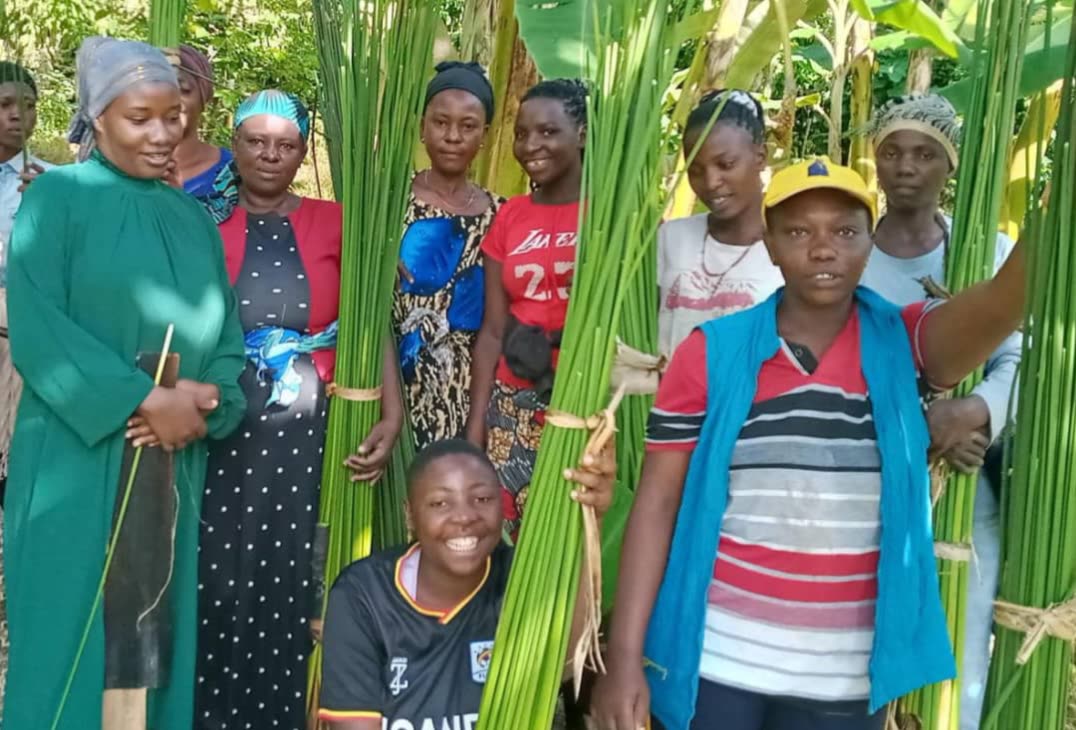
RUBIRIZI, UGANDA – Women united under the Kicwamba Women Creative Bee Initiative have turned to craft-making as a swift strategy to fight household poverty and achieve freedom from financial dependency.
Thank you for reading this post, don't forget to subscribe!This economic revolution, led by rural artisans, transforms locally made crafts, including baskets, mats, traditional containers, trays, beaded earrings, and ornaments, into tools for economic survival.
According to the Chairperson of the Kicwamba Women Creative Bee Initiative, Ms. Mukundane Scovia, members are taking bold steps to fight household poverty, painting a vivid picture of both resilience and struggle.
Scovia stated that the initiative’s greatest challenge remains access, with some members walking up to 20 kilometers just to find raw materials for their crafts.
“We do not wait for handouts to fall from the sky. We walk 20 kilometers through the dust to gather reeds and grass, we weave them with our own hands, and we turn them into school fees and food on our tables,” Scovia remarked.
Scovia emphasized the initiative’s social mission to empower women and teenage girls to reach their full potential by creating a supportive environment for girl empowerment and breaking cycles of financial dependence.
She urged the government to support the members by strengthening their operations, boosting household incomes, and equipping women with knowledge and practical skills.
“We are not asking for free things. We are asking for a chance to use what we have in our hands. Provide us with markets, and you will see poverty disappear from our homes. When you lift one woman, you lift an entire village, and when you ignore us, you keep a generation on its knees,” Scovia added.
Ms. Aine Shira, a group member, highlighted the women’s psychological and economic shift, noting their determination not to depend solely on their husbands but to generate their own income and improve their families’ livelihoods.
She laid out stark challenges threatening their progress, including limited access to affordable raw materials, lack of reliable markets, high transport costs, and insufficient support to strengthen their association.
“We have decided to stand on our own feet, not behind our husbands. But standing alone on a difficult road is not the same as walking on a paved one. We need the government to clear the way by giving us materials, markets, and transport support,” stated Shira.
The group appealed to the Ministry of Tourism to come on board, strengthen their group, provide essential materials, connect them to better markets, and give them exposure.
About the Author