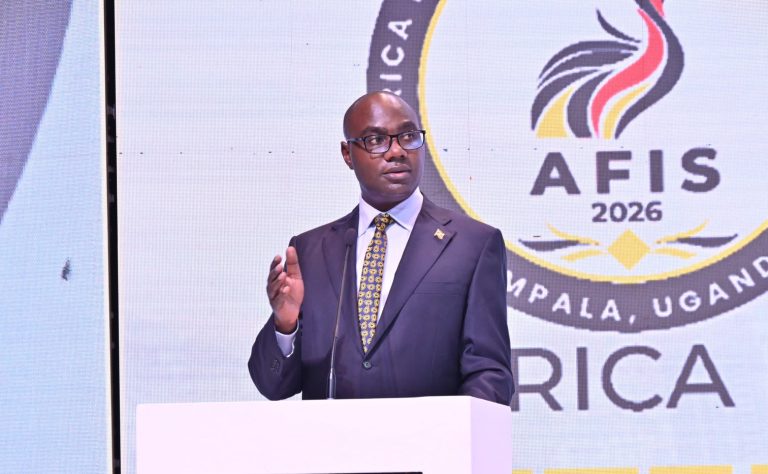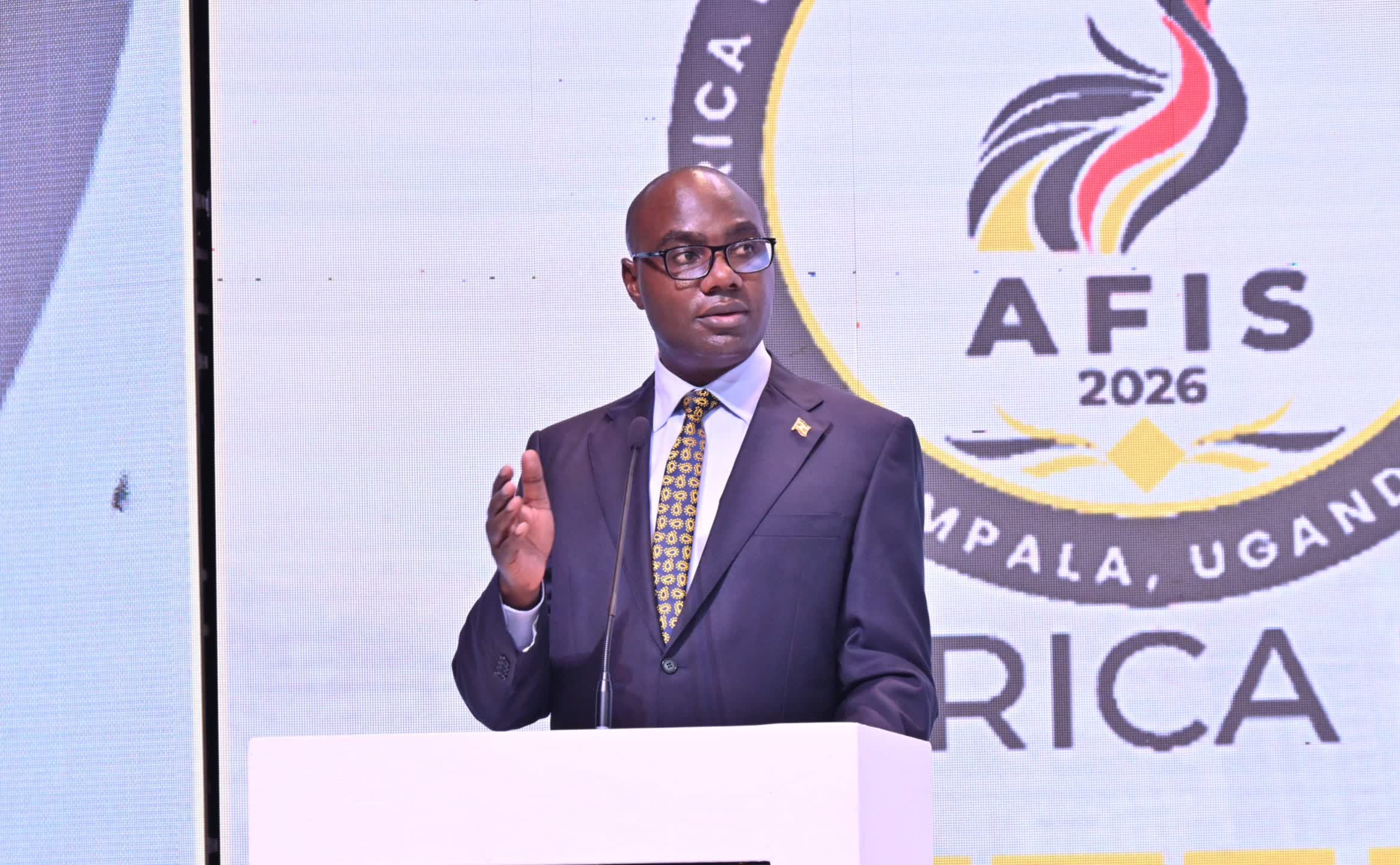
KAMPALA – The Minister of Finance, Planning and Economic Development, Hon. Henry Musasizi, has highlighted Uganda’s significant progress in strengthening its anti-money laundering framework.
Thank you for reading this post, don't forget to subscribe!The Minister made the remarks while officiating at the opening of the 2nd Africa Financial Intelligence Summit (AFRIS 2026) on Monday at Speke Resort Munyonyo Convention Centre in Kampala.
The three-day continental gathering is being held under the theme “Securing Africa’s Financial Future: Targeting Innovation and Integrated Enforcement in an Era of Borderless Financial Crime,” and brings together delegates from 36 African countries.
The participants include heads of Financial Intelligence Units (FIUs) from across Africa, law enforcement agencies, regulatory authorities, forensic investigation professionals, development partners, and private sector stakeholders, all working to strengthen cooperation in the fight against financial crime.
The Minister announced that on October 29, 2026, Uganda’s Financial Intelligence Authority became the first FIU in Africa to achieve ISO/IEC 27001:2022 Certification for Information Security Management.
He emphasized that the certification is not merely a plaque on the wall but a statement that sensitive financial intelligence entrusted by banks, DNFBPs, and partners is protected under globally certified systems of confidentiality, integrity, and availability.
“This is not a plaque on the wall. It is a statement that the sensitive financial intelligence entrusted to us by banks, DNFBPs, and our international partners is protected under globally certified systems of confidentiality, integrity, and availability,” Musasizi emphasized.
Musasizi recounted Uganda’s removal from the FATF Grey List in February 2024 after reforms that strengthened AML laws, empowered the FIA, improved inter-agency cooperation, and invested in technology to deter financial crime.
The Minister challenged delegates to address the fundamental question facing the continent: how to secure innovation, build trust without stifling enterprise, and ensure that value created in Africa stays to develop Africa.
He outlined three priorities: collaboration over isolation through stronger information sharing; technology and cyber resilience through AI and blockchain analytics; and asset recovery for development through tracing and returning stolen assets.
The Minister emphasized that convicting without recovering leaves the African citizen as the ultimate loser, calling for laws that make it easier to return stolen assets to fund schools, hospitals, and roads.
The Executive Director of Uganda’s Financial Intelligence Authority, Samuel Were Wandera, expressed gratitude to the Government of Uganda and the International Institute of Certified Forensic Investigation Professionals (IICFIP) for their support in organizing the summit.
Wandera noted that while establishing FIUs worldwide was a milestone, financial crime has evolved considerably, with criminal networks growing more sophisticated and exploiting weaknesses in financial systems and international cooperation.
“Criminal networks have become increasingly sophisticated, interconnected, and technologically enabled. They exploit weaknesses in financial systems, legal frameworks, institutional coordination, and international cooperation,” Wandera said.
He called for a shift from treating financial intelligence as an isolated institutional function toward integrated systems connecting it with law enforcement, regulatory supervision, border security, customs, taxation, prosecution, and asset recovery.
The FIA Executive Director proposed five outcomes: stronger FIU collaboration, innovative tech solutions, better law enforcement cooperation, effective asset recovery, and practical responses to digital finance threats.
Wandera also emphasized public-private partnerships, noting that financial institutions, mobile money operators, virtual asset service providers, and other accountable persons are critical sources of financial intelligence.
The summit is expected to produce actionable recommendations for strengthening Africa’s collective response to financial crime, including enhanced regional cooperation mechanisms and capacity-building initiatives for forensic investigation professionals.
About the Author