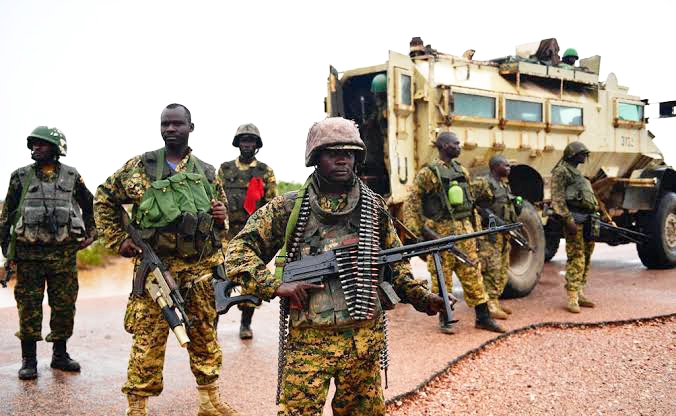
KAMPALA – The Uganda People’s Defence Forces (UPDF) has embarked on the drawdown of troops deployed in Somalia under bilateral arrangements with the Federal Government, effective immediately.
Thank you for reading this post, don't forget to subscribe!The first cohort of troops under the phased withdrawal operation has already arrived back in Uganda, with the operation expected to be completed in the coming days.
The Acting spokesperson of the UPDF, Col. Chris Magezi, confirmed that the UPDF will gradually withdraw all its forces in Somalia, including those currently deployed under the African Union Support and Stabilization Mission in Somalia (AUSSOM), by the close of 2027.
The development marks the end of Uganda’s enduring 20-year peace and stabilization support operations in Somalia, permitting the Somali Armed Forces to assume full responsibility for security in the country.
Uganda’s first deployment to Somalia in March 2007 under the African Union Mission in Somalia (AMISOM), which later transitioned to AUSSOM, marks the beginning of a nearly two-decade-long mission now coming to an end.
The Chief of Defence Forces, Gen. Muhoozi Kainerugaba, announced on October 29 that after 20 years of a lot of blood and sacrifice, Uganda is handing over security to its Somali brothers.
The first cohort of about 109 soldiers deployed under bilateral arrangements has already returned home, with locations in Lower Shabelle, including Barawe, Bulo Marer, Qoryoley, and Janaale, flagged as vulnerable following the withdrawal.
The decision to begin the drawdown comes amid a mounting funding crisis for AUSSOM, with the mission costing approximately $500 million per year in UN logistics alone and total costs exceeding $1 billion.
On July 1, the United States informed the African Union that it would oppose renewal of AUSSOM’s UN logistical backing at the UN Security Council, citing insufficient progress in security sector reforms and Somali forces not taking full ownership after nearly two decades.
Following the US withdrawal of financial contribution, the UN Support Office in Somalia (UNSOS) cut 25 percent of its support, including food, water, fuel, medical evacuation, and transport, significantly impacting frontline operations.
While the African Union Mission in Somalia (AMISOM) had been given a 12-month extension to wind down UN support from January 2027, Uganda has indicated it will not wait for funding to collapse.
About the Author