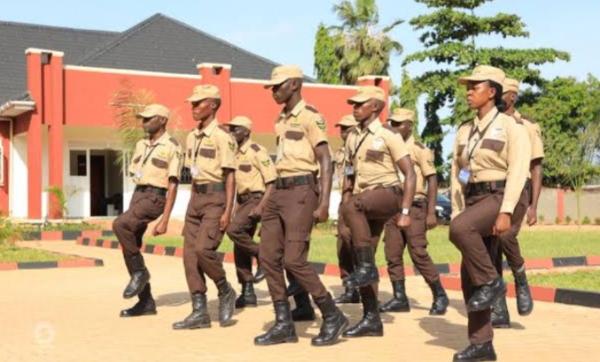
KAMPALA, UGANDA – The Uganda Police Force has taken charge of training private security guards to ensure the country has well-trained professionals who do not pose any risk to the nation.
Thank you for reading this post, don't forget to subscribe!The announcement was made by David Muhoozi, Minister of State for Internal Affairs while appearing before Parliament’s Committee on Defence and Internal Affairs considering a petition from Private Security Organisations.
The minister told the committee that the first group of 7,085 trainees is expected to complete their training on 24th April 2026, with the cost being paid by Ugandan taxpayers.
Minister Muhoozi confirmed that under the proposed regulation review, private security guards will either be trained at police training schools or receive instruction from police trainers deployed to accredited organisations at a subsidised cost to guarantee quality and standardised training.
He also revealed that the 7,085 guards currently undergoing training free of charge at police schools, representing various private security agencies across the country.
“Under proposed regulatory changes, private guards would be trained either at police schools or by police trainers deployed to accredited PSOs at subsidised cost to ensure standardized quality. As we speak now, about 7,085 are undergoing training by the police free of charge in some of our schools for private security organisations,” Minister Muhoozi said.
The Minister also revealed that a new standard training curriculum has been developed to improve professionalism and ensure consistent, high-quality services.
This training will address key security challenges, boost public confidence, and teach guards important skills like conflict resolution, surveillance, and emergency response.
Nyabushozi County MP Wilson Kajwengye backed the government’s plan to regulate private security guard training, arguing that the security business, especially when guns are involved is not like any other business.
He supported regulating the private security sector but questioned why the ministry still relies on the Police Act and Constitution instead of introducing a separate law.
The legislator warned that regulating an industry that may have more personnel than the police could be challenging, adding that it would likely distract the force or consume more resources than available.
“The security business, especially when it involves guns, is not like selling chapati or mandazi. Regulating private guards is absolutely in order, but relying on the Police Act and the Constitution is not enough. It is about time the Ministry introduced a dedicated bill for private security organisations,” urged MP Wilson.
Kajwengye noted that Uganda would not be the first country to create a specific law for private security, pointing to South Africa which has over 500,000 private guards and operates under its own Act.
Drawing from his experience living in South Africa, he recalled that they have a private security practitioner’s authority to manage their nearly half a million private security employees.
The government’s move aims to strengthen security across Uganda by ensuring all private security guards meet high professional standards.
About the Author